Apr 21, 2023
Driving Educational Excellence: A Deep Dive into SLC Academic Process Improvement
"Our commitment to delivering sustainable, scalable, and impactful solutions by placing process and people at the core of all change."
Company: SLC-Canada
Timeline: 2023-2023
Location: Canada
Industry: Education
We partner with institutions to ensure their operations are as future-proof as their educational mission. Our recent engagement in an Academic Process Improvement project at SLC- Canada exemplifies our commitment to delivering sustainable, scalable, and impactful solutions by placing process and people at the core of all change.
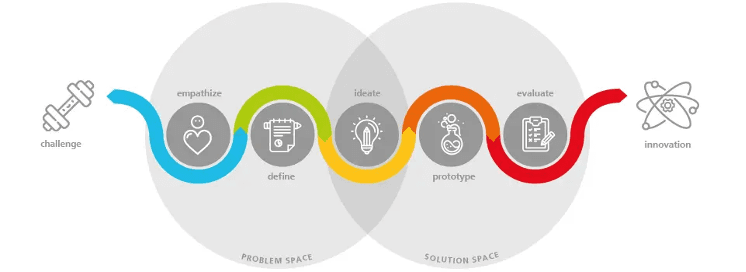
Our Approach: Uncovering the "As Is"
The project began with the aim of improving a complex academic process. What started as an intent to facilitate a single workshop quickly evolved when we realized we had opened a "Pandora's box" of deeply rooted, systemic challenges. To address this complexity, we quickly adapted our methodology:
Stakeholder-Centric Objective: Instead of a single, rushed workshop, our primary objective became to understand the various challenges from different stakeholder perspectives thoroughly. We committed to asking questions, listening intently, and taking every piece of feedback into account.
In-Depth Research Activities: Our team conducted extensive one-on-one interviews over three weeks with key players across the organization, including Associate Deans, SCTL, Academic Planning Associates (APAs), Schedulers, Human Resources, and MAO.
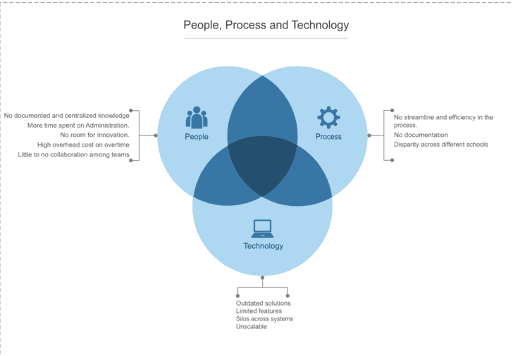
Insight Synthesis: We rigorously reviewed every interview note to identify trends and commonalities, and we redefined the core problem into digestible categories, focusing our insights on three key areas: Process, People, and Technology.
This meticulous approach allowed us to move past surface-level issues and explore the "AS IS" situations with the depth required to formulate truly transformative next steps.
Key Insights Generated from the Analysis
Our research uncovered several critical pain points and areas for process flow improvement:
Process & Time Management.
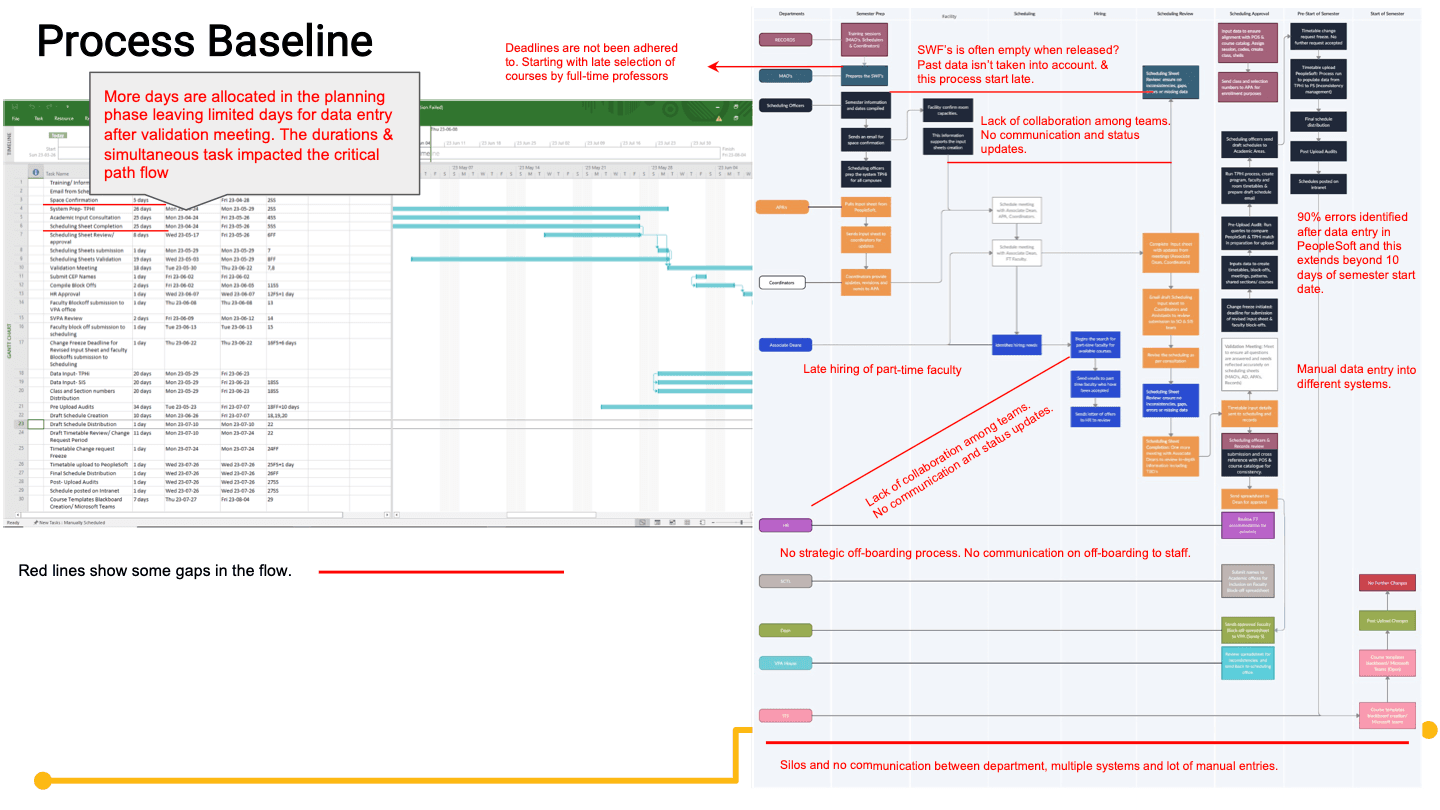
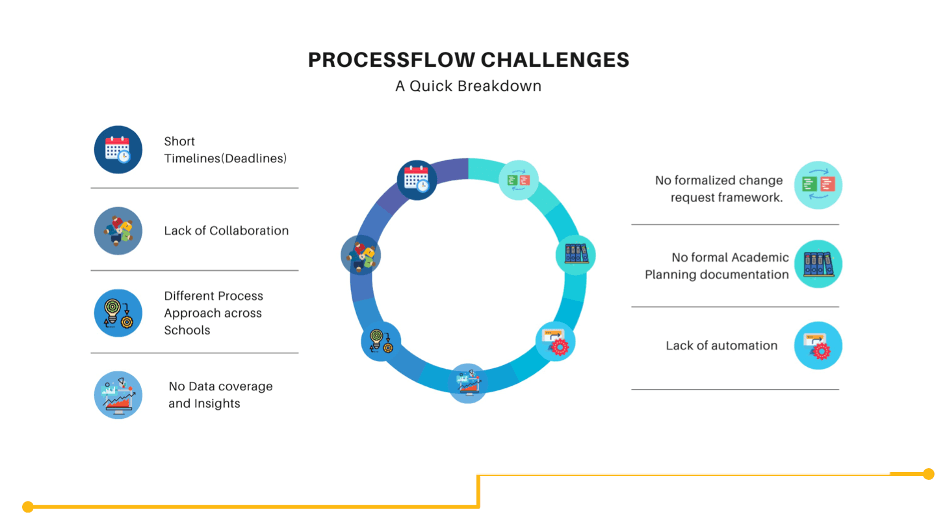
Short Timelines: The scheduling process is heavily impacted by the late release of critical documents (such as SWF), leading to semesters often beginning with significant 'To Be Determined' (TBD) items.
Manual & Inefficient Workflow: The current scheduling process involves multiple manual steps, from downloading input sheets to manually entering data into the outdated PeopleSoft system. The most time-consuming step is the initial planning and assignment of faculty to courses.
Lack of Collaboration: Despite the process being a collective effort, the flow lacks clear points for interdepartmental collaboration, creating gaps in information sharing (e.g., SCTL not receiving a list of new hires).
People & Consistency
Disparity in Approach: Different schools employ different academic planning approaches, ranging from agile methods and full-year planning pilots to following the traditional semester system. This disparity leads to misalignment in strategic objectives and inconsistent quality standards.
Lack of Standardization: A significant challenge for staff is the lack of documentation, centralized training, and standardized work processes across the tri-campus community, leading to disjointed work efforts and confusion.
Technology & Data
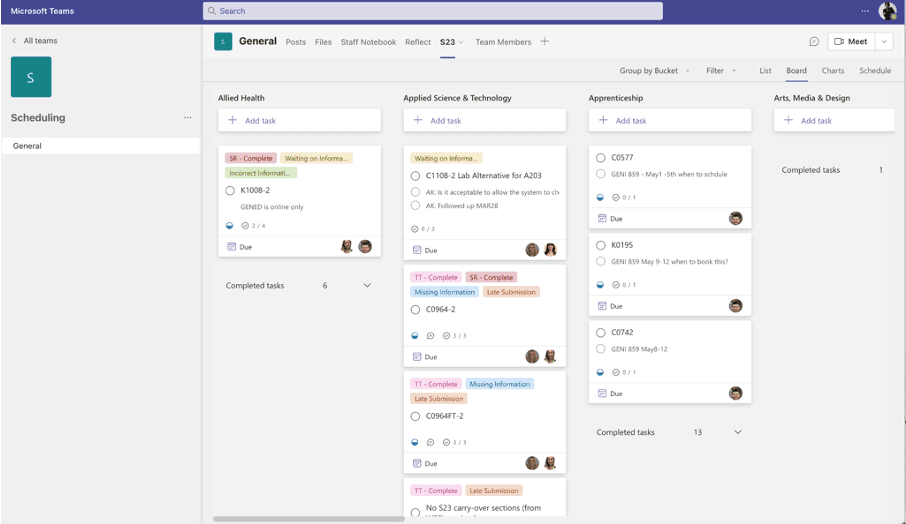
Outdated Software: The core scheduling software dates back to 1997, hindering essential tasks, requiring manual updates, and allowing single-person access, which delays the entire workflow.
No Data Coverage: The process flow is not supported by real-time or historical data. Siloed systems and people prevent data from being communicated or analyzed effectively, hindering holistic insights and proactive decision-making.
How We Work: A Focus on Future Readiness
This project perfectly illustrates our agency's foundational belief that meaningful, lasting change begins with a "radical re-imagining" that doesn't have to be a single, massive undertaking. It starts with the small things that create a collective effect.
Our service delivery is defined by:
Evidence-Based Recommendations: We don't just identify problems; we formulate tangible, priority-driven next steps. For this project, high-priority, high-feasibility recommendations included starting process documentation and exploring existing solution features.
Deep Exploration: For every challenge, we develop specific questions to guide the next phase of work, ensuring the client is equipped to facilitate conversations that lead to ideas being prototyped and tested.
A Commitment to Mitigation: We ensure our client understands the negative impacts of inaction (e.g., negative student/faculty experience, high overhead costs, limited innovation) and provide clear, actionable strategies to mitigate those risks through investment in automation and centralized knowledge.
By centering our work on the human experience, the people, process, and tools, we help our clients thrive as resilient institutions, ready to meet the continuous advancement and disruption of the modern educational landscape.
Our lead consultants on this project are Veronica Dogbegah and Esther Bonsrah.